If you are an employer with multiple hourly workers, it can be challenging to calculate pay if they work only a fraction of an hour. To pay employees working for partial hours, you need to know how to convert minutes for payroll. Failing to convert minutes when calculating pay causes errors and creates more work on the back-end.

However, it's simple if you know how to express minutes as decimals. Once time worked is converted into decimal form, such as 4.35 hours, you can multiply by the pay rate and find total wages due. To calculate the actual time worked, you need to total the hours and minutes between your employee's starting and ending times for each workday.

The timesheet below provides a good example of the information you'll start with before converting minutes to decimal form. Are you interested in how time is properly converted from hours and minutes to decimal format for payroll? We'll review and compare these two common formats for displaying and expressing time. Another common type of decimal time is decimal hours. In 1896, Henri de Sarrauton of the Oran Geographical Society proposed dividing the 24 hours of the day each into 100 decimal minutes, and each minute into 100 decimal seconds. Although endorsed by the Bureau des Longitudes, this proposal failed, but using decimal fractions of an hour to represent the time of day instead of minutes has become common.
It would be very desirable that all divisions, for example of the livre, the sou, the toise, the day, the hour, etc. would be from tens into tens. Further, the new tierce would be divided into 1000 quatierces, which he called "microscopic points of time". He also suggested a week of 10 days and dividing the year into 10 "solar months". Ratios and rates are used to compare quantities and express relationships between quantities measured in the same units of measure and in different units of measure. They both can be written as a fraction, using a colon, or using the words "to" or "per".
Since rates compare two quantities measured in different units of measurement, such as dollars per hour or sick days per year, they must include their units. A unit rate or unit price is a rate that describes the rate or price for one unit of measure. To convert minutes to hours, divide the number of minutes by 60, which is how many minutes are in 1 hour, to get the equivalent number of hours or fraction of an hour. Time, of course, is an exception because it's based on 12. The day and the night are each 12 hours, while hours and minutes are divided into 60 . While we can all calculate times quite easily, converting the 12-based system into the 10-based decimal system can often be a chore.

It is probably one of the most common types of time conversion which is done every day by many people, either in their minds or by using minutes to hours converter like this. This is especially handy if you have large values of minutes to be converted to hours. Below on the webpage, you can find a minutes to hours conversion table.

It can be used at any time as an offline tool, when you need to convert minutes to hours. Among the gifts the ancient Greeks bestowed on civilization, the familiar circular clock face and the hour, minute and second system of measuring time are among the most important. You have to do a tiny bit of extra math if you want to express the fraction in hundredths, which is usually more useful than a raw fraction. The tutorial demonstrates different ways to convert time to decimal in Excel.

You will find a variety of formulas to change time to hours, minutes or seconds as well as convert text to time and vice versa. Contrary to what some find difficult, converting minutes for payroll is easy. It just depends on whether you use rounded or actual hours worked, how you track working hours, and what tools you use to calculate.
Your main goal is to translate time worked into decimal form, so you can multiply by your employee's pay rate and find how much you owe in wages. Make up an angle measurement using degrees, minutes, and seconds. Then, using the above procedures, calculate what that angle measurement would be if it were expressed as a decimal number. Finally, enter your original angle in degrees, minutes, and seconds into this calculator, click the 'Calculate' button, and see if your conversion mathematics was correct. Only enter positive integers into this calculator.

That is, do not enter any numbers like 5.5, -5.5, or -5. Up until now, we've only discussed how to get answers written in hours. However, since time is often written as hours and minutes, it's nice to know how to do this too.

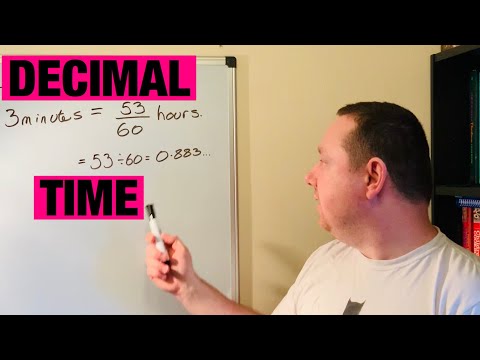
To start, just convert your minute measurement into hours like you learned in the section above. To calculate payroll to the precise minute rather than by rounding, you need to convert the minutes to a decimal. You do this by dividing the minutes worked by 60. You then have the hours and minutes in numerical form, which you can multiply by the wage rate. Numbers like 1/6 and 6/15 of an hour may be accurate, but they aren't always easy to compare with other time measurements. Converting to hundredths of an hour makes the number more useful.

Converting time to decimal format just involves basic division. There are 24 hours in a day, 60 minutes in an hour and 60 seconds in a minute. As you see, the formulas with cell references and corresponding text strings deliver identical results. Also, please notice the left alignment of time strings in cells A2 and A6 and right-aligned converted time values in column D.

To be sure you're not over or underpaying your employees, you must convert minutes worked into decimals. To perform the conversion, you can use payroll software like Gusto, an online time calculator, free minute conversion chart or a Google Sheets Minute Conversion Template. Hour is a common time measurement unit equal to 60 minutes. The unit is used and recognized by SI and has the symbol of h.

Hour as a time measurement unit is extensively used in science and is applied for defining various related measurement units like kilometers per hour, ampere-hour, kilowatt-hour, etc. Sometimes you might need to add up how much time you have spent on a task that you have completed over several days or sessions. Adding a list of hours and minutes isn't as straightforward as doing a normal addition calculation, because we are not working with a decimal system. To figure out even smaller units, you can keep doing multiple conversions to smaller and smaller units. Just make sure that the units you're using are all the same. For example, there are 24 hours in each day, but not all months have the same number of days.

To convert one year to seconds, you'll need to skip using months and convert to days, hours, minutes and finally seconds. Calendars are useful tools to help us keep track of events that are going to happen and to plan our lives accordingly. We can add information to them about important events and dates to a calendar, to help us remember what is happening when. We can read off days, weeks and months on a calendar and do conversions between these units of time.

Most of the work in this formula is done by the TEXT function, which applies a custom number format for hours and minutes to a value created by subtracting the start date from the end date. Converting minutes to decimals is as simple as dividing minutes by 60. The good news is you can skip that step if you use our minute conversion chart.

In the chart, simply find the minutes worked, between one and 60, and the decimal equivalent will be to its immediate right. For instance, the decimal equivalent of 1 is 0.02. Once you have the decimal, add it to the number of hours worked. When you choose a From_Unit, Excel automatically limits the available To_Unit arguments to valid choices, so that you won't inadvertently try to convert minutes to tons or nautical mile. The resulting amount includes a decimal value for minutes, but this is a fraction of an hour, as opposed to a fraction of a day as was shown in Figure 1.

For example, decimal days divide the day into 10 equal parts, and decimal years divide the year into 10 equal parts. Decimals are easier to plot than both minutes and seconds, which uses the sexagesimal numbering system, hours, months and days, which has irregular month lengths. In astronomy, the so-called Julian day uses decimal days centered on Greenwich noon. The Toulouse Chamber of Commerce adopted a resolution supporting his proposal in April 1897. Although widely published, the proposal received little backing. This is a unit rate; it gives the distance traveled per one hour.

The denominator of a unit rate will always be one. A rate is a ratio that compares two different quantities that have different units of measure. A rate is a comparison that provides information such as dollars per hour, feet per second, miles per hour, and dollars per quart, for example.

The word "per" usually indicates you are dealing with a rate. Rates can be written using words, using a colon, or as a fraction. It is important that you know which quantities are being compared. Unless your minutes converted perfectly to hours, you'll have an answer with a decimal or fraction in it.

Leave the whole number alone — we're only dealing with the "extra" decimal or fraction part. I am trying to multiply x number by minutes and seconds and then get the result in days, hours and minutes. Now you're ready to use the time you converted into decimal form to calculate how much you need to pay your employee. Let's assume the employee's hourly wage is $14.25. You owe $115.43 for the hours worked Tuesday.

In the two examples we just reviewed, the difference between converting minutes to decimals the wrong way versus the right way is that you short pay an employee for $3.52. Our free minute conversion chart will show you the corresponding decimal for minutes one through 60 to help you calculate gross pay accurately and quickly based on actual hours worked. In the normal way of things, to calculate how much one thing is greater than another you would simply subtract one from another. However, subtracting time is complicated because it's not decimal. Instead of the columns being hundreds, tens and units, they are hours, minutes and seconds.

Here's a calculator that will take you from angle measurement using degrees, minutes, and seconds to angle measurement expressed as a decimal number. Some decimal time proposals are based upon alternate units of metric time. Just as standard time uses the metric time unit of the second as its basis, proposed decimal time scales may use alternative metric units.

In principle, time spans greater than one second may be given in units such as kiloseconds , megaseconds , gigaseconds , and so on. Occasionally, these units can be found in technical literature, but traditional units like minutes, hours, days and years are much more common, and are accepted for use with SI. The plan did not gain acceptance and was abandoned in 1900. Multiply by "1 hour/60 minutes." Next, write a multiplication sign (×), then the fraction 1 hour/60 minutes. This fraction shows how many minutes are in an hour . When we multiply, we'll end up with the correct units, too (since the two "minutes") cancel out.

Excel has several custom formatting options for duration of time, and it will recognize most times you enter, provided you use a colon between the hours, minutes and seconds. I try to calculate total hours and minutes for below list of values. This is how you split date and time in Excel. Minute is a unit of time measurement that is equal to 1/60 of an hour. Minute is also a unit used in geometry for measuring angle, as well as for defining latitude and longitude of a point on the surface of earth. Many answers here use complicated methods to show number of hours, minutes and seconds in a proper way with leading zero - 45, 04 etc.

This works for strings so the number must be converted to string using toString(). When thinking about how many seconds there are in a year, let's first figure out the different units of measurement of time involved. We have the second, the minute, the hour, the day, the month and the year. Timetables are similar to calendars in that they help us plan our time. Where calendars are useful for planning months and years, timetables are useful for planning shorter periods of time like hours, days and weeks. You may already be familiar with timetables like those for your different classes at school, and for TV shows.

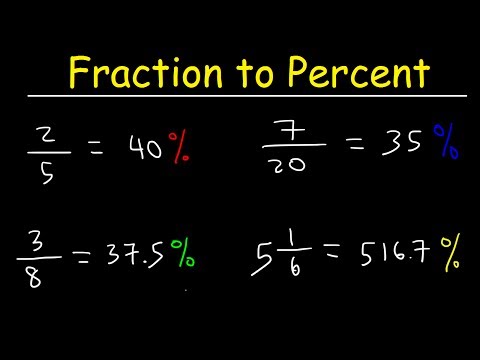
What Fraction Of 2 Hours Is 20 Minutes In this section we will learn how to read timetables and how to draw up our own. For example, if an employee worked one hour and 20 minutes, you would type 1.333 in the Duration field. The following chart shows how minutes are converted to a fraction of an hour by dividing the number of minutes by 60. Some fractions of an hour will not result in an exact number of minutes. To convert these fractions, multiply the fraction by 60 then round to the nearest minute.

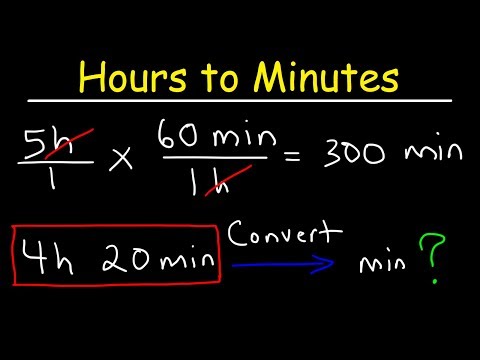
Sally travels by car from one city to another. She drives for 28.0 min at 63.0 km/h, 50.0 min at 40.0 km/h, and 50.0 min at 43.0 km/h, and she spends 13.0 min eating lunch and buying gas. Find the trip's average speed and total distance traveled... Fraction is used to represent the part of a whole thing. It is not necessary that we always convert hour into minute, we can also convert minute into hour. To convert hour into minute we multiply the term by 60 but when we convert minute into hour we have to divide the term by 60.
In this case we converted hour into minute because that makes that calculation way more easier. I need to round the 42.81 into total of hours and minutes. How do you separate elapsed minutes or seconds with thousands separator? I have calculated times between two dates and custom formatting will not let me separate the minutes or seconds accordingly. In general, there are two ways to convert time to decimal in Excel - by changing the cell format and by using arithmetic calculations or Excel time functions, such as HOUR, MINUTE and SECOND.

Further on in this tutorial, you will find the detailed explanation of the first way and formula examples demonstrating the other technique. The differences that arise with rounding your employees' working hours can add up over time. In our example, it was in the employee's favor, which meant you would be paying for more time than was actually worked. Seconds are divided by 3600 to get number of hours and a remainder, which is used to calculate number of minutes and seconds.

